

European projects
PANDORA shows how HPC, AI and Reduced Order Modelling can transform complex cardiovascular simulations into fast, patient-specific predictions.
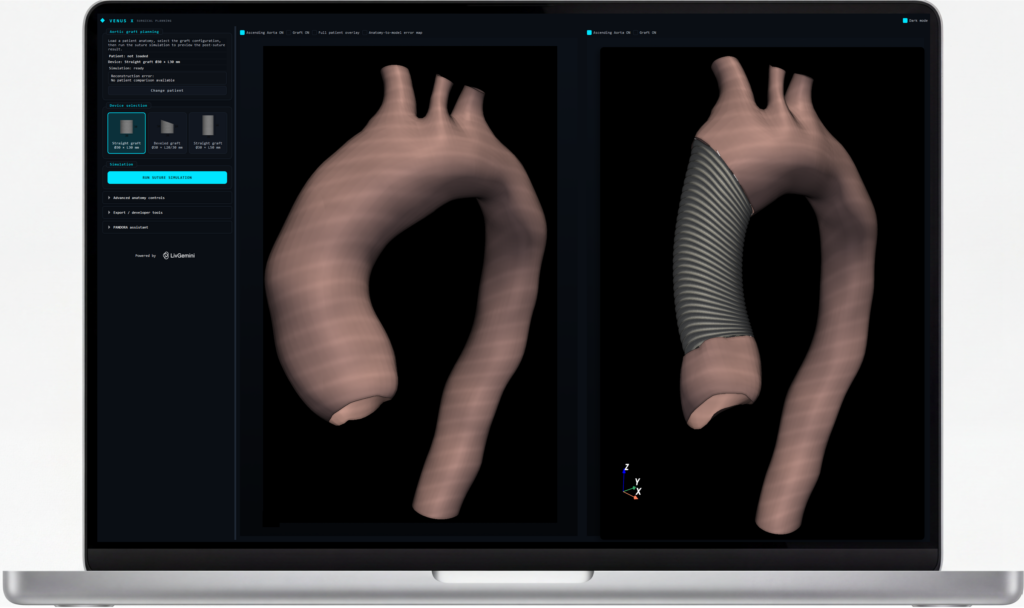
The PANDORA project has successfully reached its conclusion, marking an important milestone in LivGemini’s work to make computational simulation more accessible for cardiovascular medicine.
High-fidelity simulations can reproduce the interaction between cardiovascular anatomy, tissues and implanted medical devices in great detail. They can help assess how a vascular graft may adapt to a patient’s anatomy and how different surgical configurations may affect the final result.
However, these simulations often require extensive preprocessing, specialized expertise and significant computational resources. This makes them highly valuable for research and medical device development, but difficult to integrate into routine clinical workflows.
PANDORA was designed to bridge this gap.
The project combined high-fidelity simulations with High-Performance Computing and surrogate models. The computationally intensive analyses were performed in advance, creating a knowledge base that could then be used to generate fast predictions on standard computing hardware.
The project focused on ascending aortic surgery, where a diseased section of the aorta is replaced with a synthetic vascular graft.
The outcome of the procedure depends on several factors, including the patient’s anatomy, vessel curvature, graft characteristics, positioning and the way the surgical reconstruction modifies the native anatomy.
PANDORA aimed to go beyond conventional image-based measurements by developing a patient-specific Digital Twin capable of virtually reproducing the intervention and estimating its mechanical outcome.
Starting from medical imaging, the patient’s three-dimensional anatomy is reconstructed and used as the basis for a computational model. Different graft configurations can then be investigated virtually before surgery.
The objective is not simply to visualize the anatomy, but to provide additional information about how a selected device or surgical configuration may behave in a specific patient.
To develop predictive models capable of handling anatomical variability, PANDORA combined clinical data with synthetic anatomies.
The project began with 73 patient-specific aortic anatomies, which were used to characterize the variability of the ascending aorta. A Statistical Shape Model was then developed to generate a broader population of anatomically realistic configurations.
From this population, 2,000 synthetic anatomies were generated and 256 representative cases were selected for detailed numerical analysis.
These virtual patients enabled the project to explore how different anatomies and graft configurations may respond to the surgical procedure, moving beyond the analysis of isolated cases toward a more systematic approach to patient variability.
The selected cases were analysed through high-fidelity biomechanical simulations executed on Leonardo, the CINECA supercomputer.
This large-scale computational campaign generated the data required to train and validate the project’s Reduced Order Models and surrogate models
The high-fidelity simulations developed within PANDORA reproduce complex mechanical interactions between the patient’s anatomy and the implanted graft.
However, the final objective was not to require a supercomputer for every new patient.
The simulation results were used to develop compact predictive models capable of estimating relevant outputs without repeating the complete nonlinear analysis each time.
This approach creates a bridge between advanced engineering simulation and clinical software:
the detailed physics is computed offline, while the resulting predictive models can be used much more quickly in the patient-specific workflow.
The final user can therefore access computational information without needing to manage the underlying numerical solvers, HPC infrastructure or engineering processes.
The project also adopted the Functional Mock-up Interface (FMI) standard, packaging predictive components as Functional Mock-up Units. This supports the integration and reuse of different models within a modular Digital Twin environment.
Supporting clinical and industrial applications
For surgeons, this type of technology could support the comparison of different graft configurations and provide additional patient-specific information during pre-operative planning.
It does not replace clinical expertise or decision-making. Instead, it adds a computational layer to the information already available through medical imaging, measurements and clinical experience.
For medical device manufacturers, the same approach can support the evaluation of device performance across different anatomies and configurations.
By combining virtual populations, high-fidelity simulation and surrogate modelling, it becomes possible to explore device behaviour more efficiently during design, optimization, in-silico testing and pre-clinical development.
PANDORA brought together expertise in cardiovascular medicine, biomechanics, AI, numerical simulation, High-Performance Computing and software development.
LivGemini contributed to the development and integration of the patient-specific software environment and surrogate modelling approach.
The project also involved RBF Morph, Université de Rennes, INSA Lyon, CINECA and Ansys, combining clinical, computational and engineering capabilities.
This collaboration was essential to transform a complex research workflow into a technology that can support the development of practical cardiovascular Digital Twins.