

PNRR PROJECTS
SafeBot4Twin: Using Large Language Models to Generate Synthetic In-Silico Populations
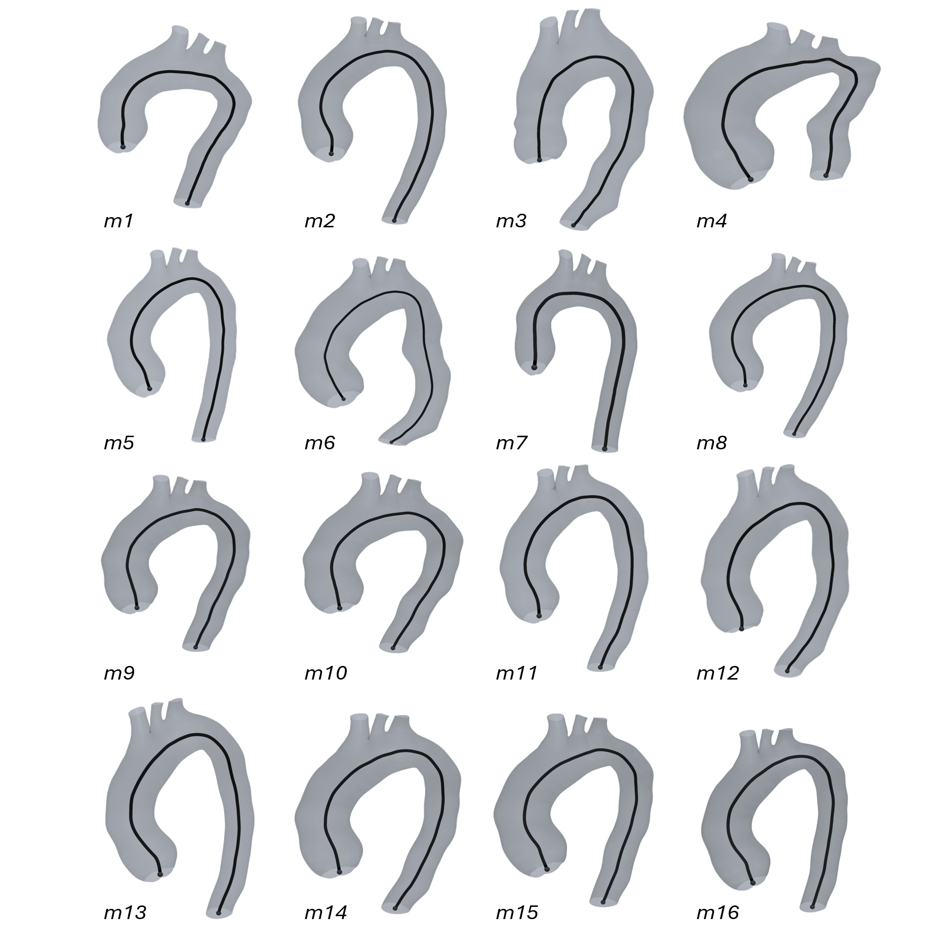
Building a realistic computational model of human anatomy is still a highly specialized task.
Creating a new vascular geometry typically requires expertise in medical image processing, mesh manipulation and simulation software. Even when patient imaging is available, generating sufficiently large and diverse populations for computational studies remains difficult: clinical datasets are limited, anatomical variability is enormous, and every additional model requires significant processing effort.
Within SafeBot4Twin, LivGemini explored a radically different approach:
What if a researcher or clinician could create and modify an in-silico patient simply by describing the anatomy they need?
Together with RBF Morph, we developed an AI-driven workflow in which a Large Language Model acts as the interface between natural language and parametric anatomical modelling.
Instead of manually editing a 3D model, users can define the characteristics of a vascular anatomy through intuitive instructions and control clinically meaningful geometric parameters such as vessel diameter, length, curvature and tortuosity.
The system translates these requests into controlled geometric modifications, generating new synthetic anatomies while preserving the structure required for subsequent computational analysis.
From one anatomy to a virtual population
The real value of this approach is not the generation of a single model.
It is the possibility of moving from individual patient-specific models to entire controlled populations of virtual patients.
Starting from a reference anatomy, geometric characteristics can be systematically varied to explore different anatomical configurations and generate large families of synthetic models.
This makes it possible to investigate questions that are extremely difficult to address using clinical imaging alone:
- How does device performance change as vessel diameter increases?
- What happens in highly curved or tortuous anatomies?
- Which combinations of anatomical parameters represent the most challenging cases?
- Can we deliberately generate rare or extreme anatomies that are poorly represented in existing clinical datasets?
Instead of waiting for the right patient to appear in a retrospective dataset, the anatomy can be generated computationally and under controlled conditions.
Enabling scalable in-silico studies
Once generated, these synthetic anatomies can become the input for computational workflows simulating cardiovascular procedures, including medical-device deployment and vascular reconstruction.
This creates a direct bridge between generative AI and physics-based simulation.
The LLM defines what anatomy should be explored.
The geometric engine creates the corresponding virtual patient.
The simulation model evaluates what happens in that anatomy.
This combination could substantially reduce the effort required to build large in-silico studies and allows anatomical variability to be investigated systematically rather than opportunistically.
For medical-device developers, this means the possibility of testing a device across a much broader design space before physical or clinical testing.
For researchers, it means creating controlled cohorts in which individual anatomical variables can be modified independently.
For AI development, it provides a potential route toward producing large, structured synthetic datasets when real clinical data are scarce.
Making Digital Twins accessible beyond simulation experts
SafeBot4Twin also addresses another important barrier to the adoption of Medical Digital Twins: usability.
Advanced computational models are traditionally operated by highly specialized engineers. An LLM-based interface changes this interaction paradigm.
Instead of learning the commands and parameter structures of a simulation environment, the user can express an objective in familiar language and allow the system to translate that intent into the appropriate modelling operations.
The LLM therefore does not replace the underlying physics or geometric model.
It makes those models easier to control.
This distinction is fundamental: the computational model remains deterministic and engineering-driven, while generative AI provides an intuitive layer through which users can interact with it.
Toward virtual patients on demand
For LivGemini, SafeBot4Twin represents an important step toward a broader vision of computational medicine in which patient-specific Digital Twins and synthetic populations coexist.
Patient data remain essential for reproducing the anatomy of an individual.
But synthetic models provide something different: the ability to systematically explore what could exist, not only what has already been observed.
By combining Large Language Models, parametric geometry and physics-based simulation, SafeBot4Twin lays the foundation for a new generation of in-silico platforms in which virtual anatomies can be generated, modified and tested at scale.
From describing an anatomy in natural language to creating a simulation-ready virtual patient: SafeBot4Twin shows how generative AI can become an interface for in-silico medicine.